|
| Your Oil Is Talking, Are You
Listening?
 Right now, the oil working in your crankcase,
gearbox, or sump contains information that could be
vital to the performance and productivity of your
engine or equipment. Contaminants that can indicate
wear or cause serious equipment damage such as
metals, water, raw fuel, acids, fuel soot and other
solids collect in your lubricant. Using oil analysis
to evaluate these contaminants is a scientific
approach to predictive maintenance, allowing you a
look inside your machinery to spot mechanical wear
and contamination in its early stages. You'll extend
machine life, head off major maintenance costs and
prevent catastrophic failure that can shut down or
leave you stranded, and you'll maximize lubricant
life.
Right now, the oil working in your crankcase,
gearbox, or sump contains information that could be
vital to the performance and productivity of your
engine or equipment. Contaminants that can indicate
wear or cause serious equipment damage such as
metals, water, raw fuel, acids, fuel soot and other
solids collect in your lubricant. Using oil analysis
to evaluate these contaminants is a scientific
approach to predictive maintenance, allowing you a
look inside your machinery to spot mechanical wear
and contamination in its early stages. You'll extend
machine life, head off major maintenance costs and
prevent catastrophic failure that can shut down or
leave you stranded, and you'll maximize lubricant
life.
|
Oil Analysis Provides a Big Return for Your
Small Investment by:
- Extending equipment life by preventing
premature component failure
- Reducing maintenance costs by eliminating
unnecessary component changes and decrease
downtime due to premature scheduled maintenance
- Enabling calculation of optimum drain
intervals that will reduce lubricant costs and
assure maximum equipment protection
- Eliminating complete teardowns based on
guesswork
- Reducing unscheduled maintenance - keeps
equipment up and running
- Enabling better assessment of equipment
performance
|
| Oil Analysis - A Proven Industry Standard
Maintenance Tool
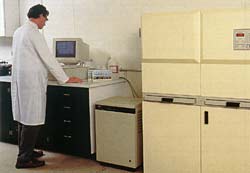 Used oil analysis has existed as long as lubricants
have been around. In the 1940s, the railroad
industry began to analyze their lubricants for their
various metals found in specific components of the
engine. By tracking wear rates and trends from one
sample to the next, maintenance could be anticipated
and scheduled before component failure resulted in
downtime and the loss of equipment productivity.
This data allowed railroads to schedule teardowns
when they were necessary, rather than after an
arbitrary number of operating hours. The advent of
spectrometric metals analysis gave rise to the
practice of "predictive maintenance" which continues
to be more cost effective than the standard of
preventive maintenance. The oil analysis process
consists of (1) lubricant sampling, (2) laboratory
analysis and (3) interpretation of the results to
determine the condition of the fluid and the
machinery from which the sample was taken.
Used oil analysis has existed as long as lubricants
have been around. In the 1940s, the railroad
industry began to analyze their lubricants for their
various metals found in specific components of the
engine. By tracking wear rates and trends from one
sample to the next, maintenance could be anticipated
and scheduled before component failure resulted in
downtime and the loss of equipment productivity.
This data allowed railroads to schedule teardowns
when they were necessary, rather than after an
arbitrary number of operating hours. The advent of
spectrometric metals analysis gave rise to the
practice of "predictive maintenance" which continues
to be more cost effective than the standard of
preventive maintenance. The oil analysis process
consists of (1) lubricant sampling, (2) laboratory
analysis and (3) interpretation of the results to
determine the condition of the fluid and the
machinery from which the sample was taken.
|
| Who is Using Oil Analysis?
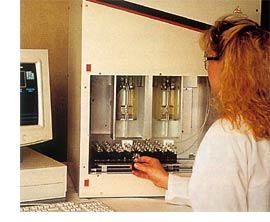 An oil analysis program can provide critical
information for any equipment requiring lubricants -
both gasoline and diesel engines, transmissions,
gears, bearings, and hydraulic systems. It's useful
for owners of passenger cars, over-the road fleets,
off-highway equipment, boats, or high performance
vehicles. It's also essential for various industries
that focus on managing plant equipment and
maintenance costs. As a matter of fact, as many as
70% of today's construction equipment operators use
professional oil analysis to assess equipment and
lubricant condition. Forty percent of all
transportation fleets and 20 percent of industrial
plants also rely on lubricant testing as an integral
part of predictive/preventive maintenance. These
businesses know that oil analysis replaces the
guesswork in predicting equipment wear and
scheduling optimum drain intervals. The data
provided by oil analysis enables them to maximize
equipment profitability by minimizing maintenance
downtime.
An oil analysis program can provide critical
information for any equipment requiring lubricants -
both gasoline and diesel engines, transmissions,
gears, bearings, and hydraulic systems. It's useful
for owners of passenger cars, over-the road fleets,
off-highway equipment, boats, or high performance
vehicles. It's also essential for various industries
that focus on managing plant equipment and
maintenance costs. As a matter of fact, as many as
70% of today's construction equipment operators use
professional oil analysis to assess equipment and
lubricant condition. Forty percent of all
transportation fleets and 20 percent of industrial
plants also rely on lubricant testing as an integral
part of predictive/preventive maintenance. These
businesses know that oil analysis replaces the
guesswork in predicting equipment wear and
scheduling optimum drain intervals. The data
provided by oil analysis enables them to maximize
equipment profitability by minimizing maintenance
downtime.
|
The Oil Analysis Program From Oil Analyzers,
Inc.
- State of the art Laboratory and testing
instrumentation
- Web based and Email Reporting for fast
turnaround
- User Friendly, Pre-Addressed Sampling Kits
- Accessible Customer Support for Questions
and Concerns
- Maintained Data History for Trending
Analysis
- Easy To Read Recommendations
|
|
| |
 |
|
|
 |
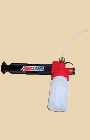 |
AMSOIL Sampling Pump
The
sampling pumg comes with a 10 foot
tube for inserting down the dipstick
tube of the vehicle in question, it
also has a probe needle on the front
for drawing oil samples from
preasurized systems.
Product Code: G1206 |
|
 |
|
|
|
|
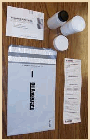 |
Oil
Analysis Kits
AMSOIL
provides oil analysis service
options. By analyzing used engine
oil, a qualified lab can detect
mechanical problems your engine may
have.
Product Code: G1451 |
|
|
|
|
|
|
|
|
|
| |
|
|